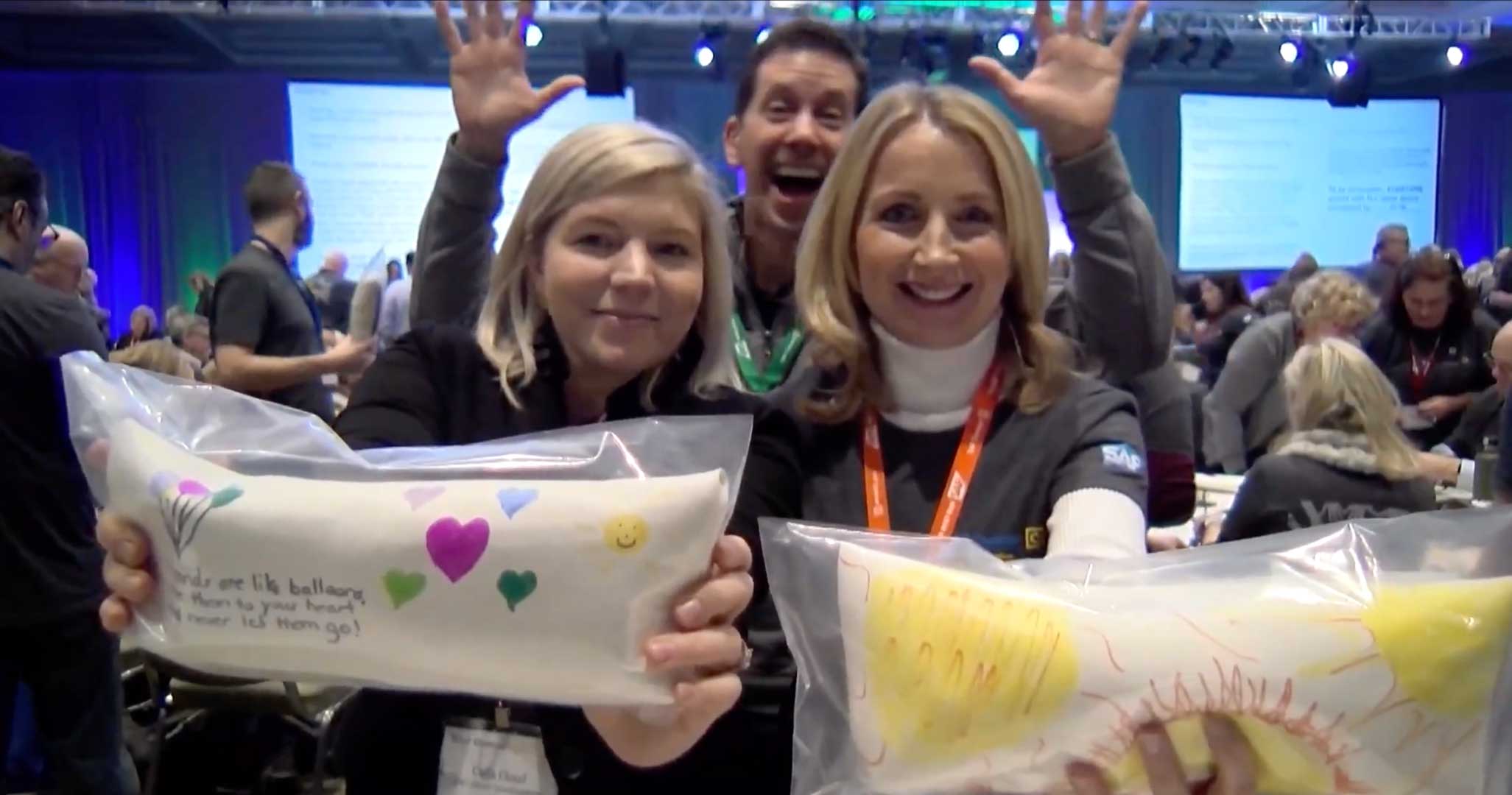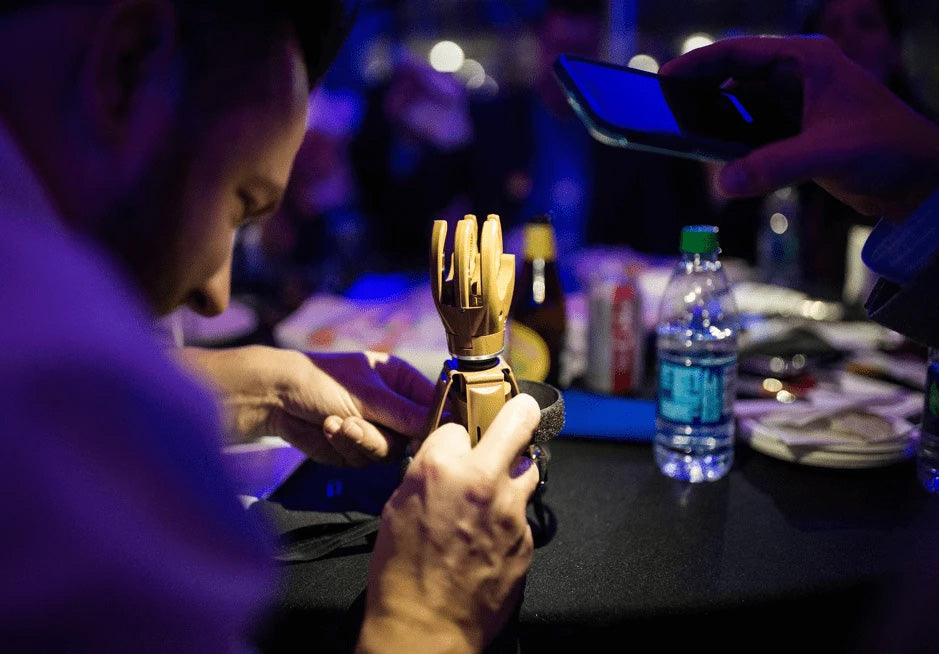
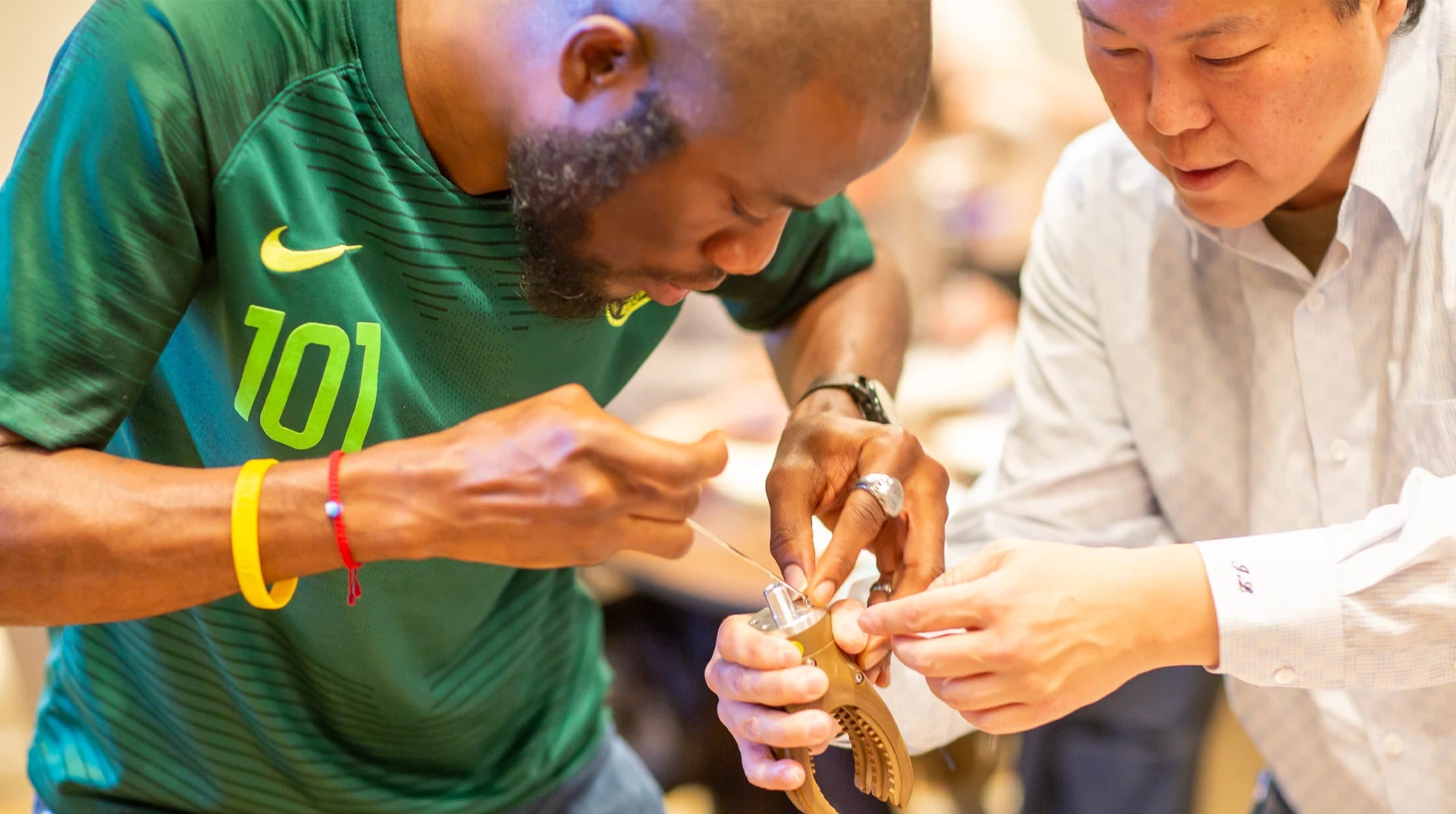
Some matches are made in heaven. Lain Hensley, COO and co-owner of Odyssey Inc., will tell you that when he met Michael Mendonca, president of the LN-4 Foundation, he felt magic in the mix. LN-4, the Ellen Meadows Prosthetic Hand Foundation, was created by engineer and inventor Ernie Meadows in loving memory of his daughter. Devoted to uplifting the lives of disadvantaged people across the globe, LN-4 manufactures and distributes prosthetic hands to children in developing countries. In 2008, LN-4 joined forces with Odyssey to create Helping Hands, a life-changing, philanthropic team building workshop. And we believe, the most empowering experience in our portfolio. With Helping Hands your group will be challenged to assemble brand new, highly functional, prosthetic hands that will be distributed through LN4 to children in developing nations who have lost limbs through conflict, disease and birth defects. By participating in Helping Hands, your team will have a front-row seat and hands-on participation in changing the lives of disabled children. And few participants can escape the experience without the feeling that they too have been changed.
This program combines curriculum, activities and keynote addresses with the cooperative problem-solving exercise of actually assembling the prosthetics. It leverages the hyperbolic speed of change and technology and resurrects the essence of a community work ethic. It’s the secret to manifesting what’s held in the imagination. We call it “believing beyond the evidence.” It’s revolutionary, because it’s evolutionary. It’s a skill reserved for people, businesses and organizations that aren’t afraid of shining their best light. Is that you?
We all want to contribute something tangible. But we’re often left feeling insignificant and small. Helping Hands changes all of that. We will show your team how to step outside perceived limitations to the place of possibility. The lessons learned in Helping Hands can be applied to work, relationships and a way of living authentically and with purpose. We’ll help you develop skills that go beyond the traditional definitions of what it means to be successful. And you’ll bear witness to the fact that your actions can – and do – make a difference.
Get The Facts:
Through our partnership with Rotary International, each hand will be delivered within six months to children and adults who would otherwise not be able to afford a prosthetic hand. There are over 2,000 landmine accidents every month in the world, and many result in the catastrophic loss of limbs. Thanks to your generosity, people affected by these tragedies, as well as disease and birth defects, receive the Helping Hands prosthetics for free so they can lead more productive lives. After the event, photos will be posted online for participants to see the faces of those receiving the Helping Hands.
Choose a Helping Hands™ format below based on business application and duration:
Helping Hands™ - Accessing Potential - lessons for thinking outside the box
Duration: Four Hours
Why? Constraints in our work environment and in our own way of thinking often suppress any possibility of change or innovation. As leaders and team members, we must move with urgency beyond these defaults if we’re going to build strong, powerful, resilient companies and teams.
Can you afford not to look for new ways of compelling your people to reach higher in what they can become?
Business application: The assembly of the LN-4 Hand is a real example of accessing potential and thinking outside the box. The process and progression of the program exposes a series of ‘tipping’ points – applicable lessons that can impact every aspect of your business.
Helping Hands™ – Collaboration and Team Engagement - lessons for making teamwork work
Duration: Three to four hours
Why? Too often employees lose the context of how important their actions are to the greater good of the team, their customers and the community. This leads to petty, superficial difficulties in communicating, silo mentality and employee disengagement.
Business application: After the assembly of the Hands, participants identify the major benefits of your company’s products/services, and they discuss the top three things they can do to improve both collaboration and employee engagement.
Helping Hands™ – Thematic Integration
Duration: Two to Four Hours
Why? Your meeting’s theme and the values that drive performance must come to life for your next meeting/conference to be your most memorable and relevant team experience to date. We’ll work with you to integrate your key messages with our own for a truly transformational experience.
Business application: When participants get the message in their bones, they emerge with a new level of commitment, and the impact of your meeting will stick with them long after the program ends.
**After the Helping Hands program:**
- Follow up! The Odyssey's Tipping Points™ process extends the shelf life of the event dramatically by reminding participants regularly of the lessons that shaped their unique experience.
- We have a fleet of follow-up programs, tools, and resources for post-program review and consultation, integrating values and messages to make them stick.
**Metrics and assessments:**
- Inquire about incorporating the Denison Culture Survey (http://www.denisonconsulting.com/dc/) to measure specific cultural traits in your team that impact the bottom line. Additional costs apply.
- History of the LN-4 Prosthetic Hand and the need it serves.
LN-4 Prosthetic Hand Project
A few years ago, Ernie Meadows and his wife suffered the loss of a child. Meadows, an engineer and inventor, decided he was going to do something for the rest of the world in honor of his daughter’s life – a selfless, no-money-to-gain act that would benefit children across the world in some way. Learning of the hundreds of thousands of children who had lost hands and other limbs due to land mines inspired Meadows to invent and design a prosthetic hand that was fully functional and could be made, fitted and used for literally pennies on the dollar compared to the other prosthetic hands available on the market.
Q. How does the hand work?
A. Two movable mechanical digits interlock with three immobile digits. The movable digits hold at incremental points while closing by a ratchet-type mechanism. Simple pressure from either the other hand, a table or against your leg is all that’s needed to close the digits. Putting pressure on the back of the hand flexes the base and pulls tabs away from the digits’ gears, releasing the grip.
Q. Who is the hand designed for?
A. It was invented and designed for hand amputees ages 3 to 8 whose arms extend at least six inches below the elbow. Some 500,000 children worldwide could benefit from this type of device, but accurate numbers are often underreported and difficult to track. In Vietnam, we learned that teens and some adults can also use the hand. We may eventually manufacture a larger hand.
Q. Why does it cost nothing to recipients?
A. Everyone willingly chips in – the inventor, the toolmakers, the designers and the manufacturers. This hand is being manufactured for no profit, so the recipients receive them for no charge!
Q. Who are initial sponsors?
A. The National Institutes of Health (NIH) provided a grant for design and development. Many individuals, businesses and even youth groups have also contributed to the start up costs of this great effort. Rotary International has also played a key role in funding, partnerships and distribution, with special thanks to District 5160 and District 5110 (Southern Oregon), in addition to the many other clubs who have participated in this project. Odyssey Teams Inc. has played a vital role in the assembly and distribution of the LN-4 Hand and Dream Box.
Q. What are your future goals?
A. By setting up a 501(c)(3) nonprofit corporation called – appropriately – “The Ellen Meadows Prosthetic Hand Foundation,” and working with great organizations like Rotary, we intend to manufacture, distribute and provide leadership to this effort in order to make it a worldwide project. We anticipate making and distributing literally tens of thousands of hands and doing so for at least the next 100 years.
LN-4: Prosthetic Hand Project
BACKGROUND & FUTURE TIMING
- November 2004 – Rotary Club of Pleasant Hill and St. Andrews Presbyterian Church Youth Group funds the initial prototype LN-4 Hands to go to Vietnam.
- Feb/March 2005 – Group to Vietnam and pays for its own transportation and accommodations, puts on the first 7 hands and makes video of project. Much is learned!
- April 2005 – Presentation to Oregon District Conference 5110 of Vietnam trip. Past RI President Frank Devlin voices his support and GSE Team Leader from Nairobi offers to partner next trial in Kenya for up to 50 hands!
- April-May 2005 – Feedback from Vietnam is very positive on the longer term value/use.
- Individuals, corporations and Rotary clubs support the production of 50 hands which incorporate new improvements based on key findings from Vietnam.
- May 2005 – U.S. team formed (4 Rotary Clubs, 8 people – 6 Oregonians, 2 Californians) commits to go to Kenya (November 2005) for next test – raises goal to 100 hands!
- June 2005 – Application submitted for Individual (Travel) Grant to TRF.
- July-August 2005 – Group meeting of U.S team, other Rotarians, hand inventor, tool-maker, designer and manufacturer. New parts are finalized and “metal cutting” begins.
- August 23, 2005 – Approval given to build molds.
- September/October – Tooling produced, hands manufactured, supplies ordered.
- October – Hands assembled, cuffing mechanism manufactured.
- October 15, 2005 – Team meets in Oregon for planning and training on hand use and overall strategy in Nairobi.
November 4-18 – Team travels to Nairobi for next test in conjunction with Jaipur Foot Project – prosthetic leg center and District 9200.- November 7, 2005 – Arm band strap redesigned on-site at Jaipur – a true miracle!
- 74 Hands put on in 3 African nations – Kenya, Uganda, and Tanzania – all with great success!
- November-December 2005 – Follow-up reports received from Africa.
- January-February 2006 – Decision and structure of forming 501(c)(3) nonprofit corporation.
- May & August 2006 – Return trips to Africa for face-to-face follow up and as guest speakers at the District 9200 Conference.
- December 2006 – Full-scale launch of “The Ellen Meadows Prosthetic Hand Foundation!”
- March 2007 – A return trip to Vietnam with 5 Rotarians yields national coverage and 3 locations with staffs that are now trained to continue the project. An additional 36 hands were also put on during this successful trip.
LN-4: Prosthetic Hand Project
THE NEED
- United Nations estimates that there are currently 100 million ‘active’ landmines in 60 countries and 250 million stockpiled and ready to deploy.
- 2,000 people landmine accidents every month
-
- One person is injured every 20 minutes.
- Around 800 of these will die.
- 1,200 will be maimed.
-
- 300,000-400,000 known landmine-related amputees, of whom 20% are children. There are up to 500,000 total, and 25,000-50,000 without hands. And 95% of these are civilians.
- 5,000-10,000 are added to this number each year.
- 75% of mine-blast survivors have at least one amputation.
THE COST
- In 'developing' countries, it costs at least $3,000 USD to give someone an artificial limb.
- In Cambodia, 61% of mine victims went into debt to pay for their medical treatment.
- In Afghanistan, the number is 84%.
Additional Information: Statistics by Country/Region
Afghanistan – 9-10 million landmines (3 people per day are killed/injured, 100,000 total injured/dead)- Angola has 9 million landmines.
- Chechnya (3,445 casualties as of September 2004)
- Iran (4,000 fatalities, 6,000 injured)
- Iraq – 5-10 million landmines (5.4 million people live within 1 kilometer of heavily concentrated landmine/UXO affected areas)
- Jordan – 305,000 landmines
- Cambodia – 4-7 million landmines (35,000 landmine amputees)
- Angola – estimated 70,000 amputees many of whom are children
- Mozambique – 1-2 million landmines
- Western Sahara – 1-2 million landmines
- Bosnia Herzegovina, Croatia, and Somalia – each with 1 million landmines
- Vietnam – 3.5 million landmines
The story of: One little boy
A 4-year-old Vietnamese boy was carried into the room by a caretaker. The boy had only one limb…I repeat, only one limb…a right leg! His right arm was gone just below the elbow and his left arm just above the wrist. His left leg also missing but fitted with a prosthetic. The boy screamed and yelled upon entering the room at the sight of all the prosthetic hands lined up on the table. His caretaker took him outside to calm him down. Ten or fifteen minutes later, the care taker brought him back into the room, and again he started right up with the crying and screaming. In a moment of desperation, I decided to give him one of the prosthetic hands, and in the same moment I questioned my decision as I wondered whether that was such a great idea – I mean, how could a child “play” with such a device by having available to him only the stubby ends of two arms that aren’t even the same lengths?
I was told once that if the only tools in your toolbox are a hammer and a screwdriver, then you tend to think of your solutions in terms of using only that hammer and that screwdriver. Well, he did just that. He instantly calmed down and was able to hold the prosthetic hands between the ends of his two arms. He began experimenting with it and in a few short moments, realized how the device worked. With a little help from his caretaker, he also figured out how to tighten the digits (fingers) and release them.
He stayed in the room clutching the prosthetic hand and watched while we put hands on several other people. Nearly an hour passed until it was his turn and by that time, he was so ready to have his hand put on that when he and his caretaker sat down, he literally reached out his left arm as if to say, “Quit fooling around and put this thing on me!” We did just that, and literally within one minute, he had managed to put a marking pin in the hand and for the first time in his life, draw on a piece of paper.
The room was flooded with emotion. How many opportunities do we have in life to be able to impact another person to this extent?
A couple of weeks later I received an e-mail from Vietnam indicating that the boy not only loves and uses his hand, but he doesn’t want to take it off at night when he goes to bed.
Rest well, little child. Hopefully you can have the same opportunity that we have had – to experience the gift that you have given us.