

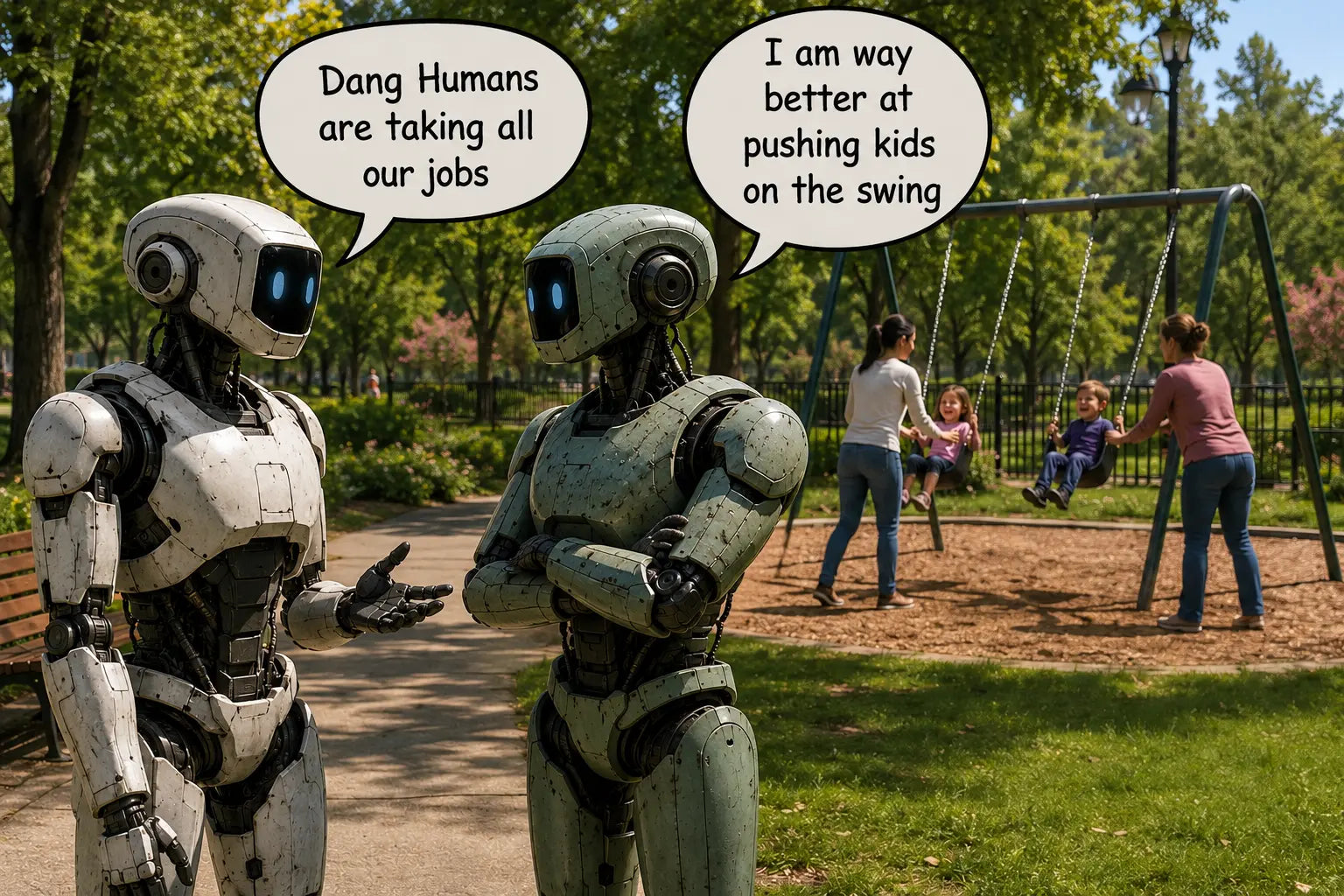
At some point, enough will be enough with the accelerating A.I. takeover. We all understand that artificial intelligence and robotics will shape the future, but the real question is where we draw the line. Human work and contribution have driven every major advancement in history. Every invention, breakthrough, and movement that reshaped the world began with human imagination, struggle, sacrifice, and purpose. The issue isn’t whether technology will advance. It will. The issue is whether humanity will still matter when it does. This is the heart of the debate around human skills vs AI—not whether machines will get smarter, but whether humans will stay essential.
The Emotional Cost of Automation
Simon Sinek famously says to “Start With WHY.” But in a world increasingly dominated by automation, many people may soon begin asking a different question: “WHY ME…if a robot can do it?” That question is dangerous. Work is about far more than productivity. Human work creates dignity, identity, purpose, innovation, and connection. People don’t work only to earn money—they work to contribute, to create, to solve problems, and to feel needed. A society that removes the need for human contribution risks creating a generation that feels replaceable. Research from the World Economic Forum reinforces this concern, showing that a vast majority of employees believe uniquely human skills will become even more important as AI grows, and that people are craving more human connection, not less.

The Real Danger Isn’t AI — It’s Losing the Value of Human Contribution
History already shows what happens when automation outpaces humanity. Between 2000 and 2010, the United States lost nearly six million manufacturing jobs, much of it due to automation and outsourcing. Oxford researchers estimate that nearly half of all jobs could eventually be at risk as automation expands. The World Economic Forum predicts that while AI will create new roles, millions of workers will be displaced in the transition, and many will be left behind. Efficiency may rise, but efficiency alone does not build strong communities or meaningful lives. Even the most advanced AI systems still rely on humans. Every algorithm, chatbot, and robot depends on human-created data, human oversight, human ethics, and human creativity. AI doesn’t think; it predicts patterns based on information people already produced. In other words, the future of AI still depends on human intelligence—but for how long?
The Human Skills AI Cannot Replace
Across industries, research is converging on one truth: the most valuable skills in the age of AI are the ones only humans can provide. McKinsey notes that AI can write, design, code, and complete tasks at breakneck speed, but it cannot set aspirations, build trust, make tough calls, or generate truly new ideas. These remain deeply human responsibilities. Forbes emphasizes that empathy, judgment, creativity, and adaptability are becoming foundational, not optional, in an AI-driven world. The CFA Institute adds that employers increasingly value human skills like judgment, empathy, communication, and relationship-building as essential differentiators in the AI era.
Leadership is one of those abilities. AI can analyze data, but it cannot set vision, read a room, or mobilize people. Leadership requires emotional intelligence, courage, and the ability to inspire—qualities no machine can replicate. Empathy is another. Bots can respond, but humans can care. Empathy builds trust, resolves conflict, and strengthens teams. Creativity also remains uniquely human. AI can remix ideas, but humans can invent them. Teamwork is a distinctly human strength as well. AI can coordinate tasks, but humans build relationships. And purpose—perhaps the most important human skill of all—cannot be automated. Machines can execute, but humans can mean.

The Psychology Behind Feeling Replaceable
One of the most overlooked aspects of the human skills vs AI debate is the emotional impact of automation. When people fear being replaced, they don’t just worry about income; they worry about identity. Psychologists call this “purpose displacement.” When a person’s work is automated, they often feel less valuable, less capable, less connected, and less necessary. Humans are wired for contribution. We want to matter. We want to be needed. We want to feel like our presence changes something. AI threatens that—not because it is malicious, but because it is efficient.
Why Human Skills vs AI Matters for Company Culture
Culture is built on human behavior, not algorithms. When organizations over-automate, culture suffers. Conversations become transactional. Collaboration becomes optional. Mentorship becomes rare. Creativity becomes constrained. Shared purpose becomes diluted. AI can support culture, but it cannot create it. A thriving culture requires leaders who listen, teams who trust, people who care, and experiences that bring individuals together in meaningful ways. These are the foundations Odyssey Teams has built programs around for more than 30 years.
Real‑World Examples of Human Skills Outperforming AI
In healthcare, AI can detect patterns in scans, but human doctors outperform machines in communication, trust-building, and complex reasoning. In education, AI can tutor, but teachers inspire. They read emotions, adapt in real time, and create belonging. In leadership, AI can analyze data, but it cannot rally a team through uncertainty or make values-based decisions. In customer experience, AI can answer questions, but humans create loyalty. Every industry reveals the same truth: AI can assist, but humans connect.
Where Odyssey Teams Fits Into This Future
This is where Odyssey Teams becomes not just relevant, but essential. For more than three decades, Odyssey Teams has designed experiences that strengthen the human skills no machine can replicate—leadership, empathy, creativity, teamwork, and purpose. Our experiential learning programs, from Build-a-Hand to Life Cycles to Team Mosaic , are built on one belief: technology may build the future, but only humans can give it meaning. Odyssey’s programs help teams practice the very skills AI cannot replace. They create environments where people connect, collaborate, innovate, and contribute to something bigger than themselves.

Why Experiential Learning Matters More in the Age of AI
As AI accelerates, experiential learning becomes one of the most powerful tools for developing human skills. Research from the World Economic Forum shows that employees crave more human connection as AI grows. Experiential learning builds empathy through shared experiences, strengthens leadership through real-time challenges, sparks creativity through hands-on problem solving, deepens teamwork through collaboration, and reinforces purpose through meaningful contribution. These are the skills that will define the next generation of leaders, and they cannot be downloaded, automated, or outsourced.
The Call to Action: Protect What Makes Us Human
The danger is not technology. Technology has always improved human life. The danger is allowing efficiency to become more valuable than humanity. We must build a future where AI handles the repetitive and humans handle the meaningful, where AI accelerates tasks and humans accelerate purpose, where AI supports and humans lead. Because at the end of the day, robots may help build the future, but only humans can give it meaning.
If you’re looking for additional ways to bring purpose, and connection into your organization, explore our full CSR Team Building Experiences and discover programs that align with your culture and mission.
Share:
What One Hand Can Do: The Impact‑Driven Build‑a‑Hand Team Building Journey to 100,000 Prosthetic Hands
Steady in a Shifting World - Reiner Wiederkehr