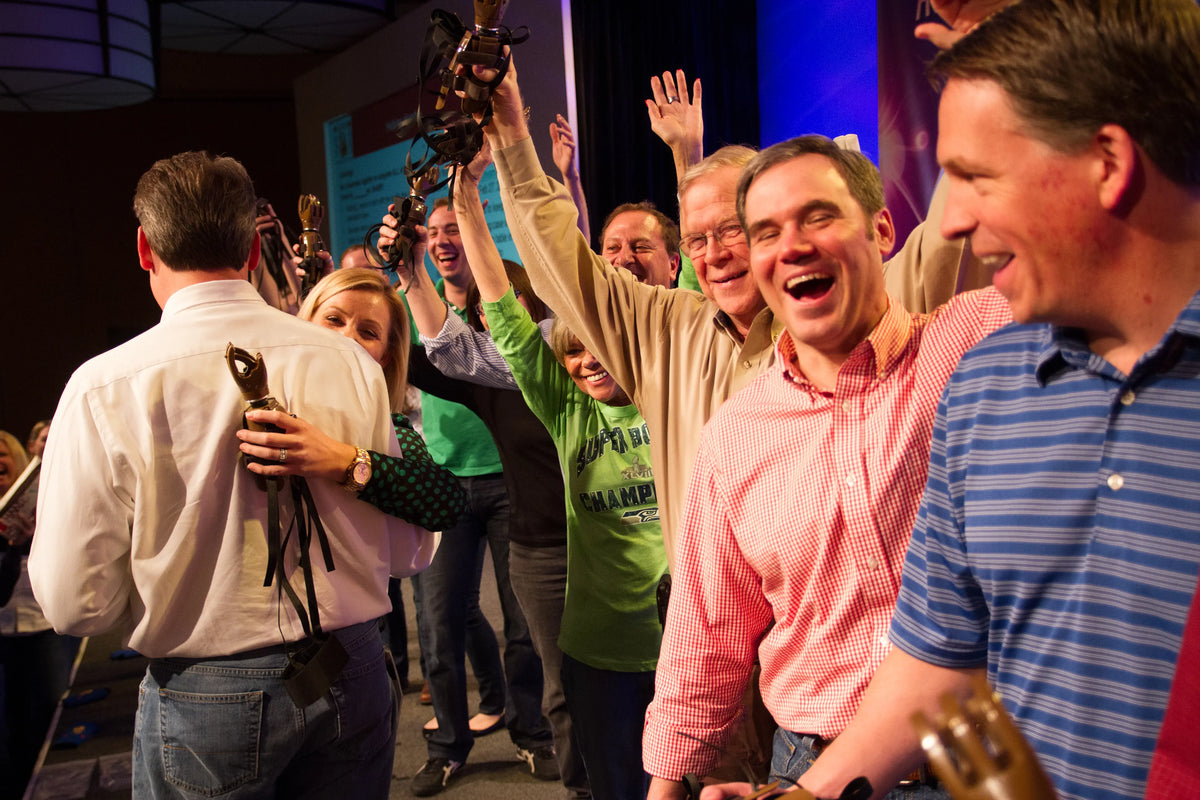
Team building activities that give back to the community combine employee development with meaningful social impact. Instead of simply entertaining employees, teams work together to accomplish something tangible—building a prosthetic hand, bicycle, skateboard, playhouse, or another item that benefits a real person or community.
Done well, these experiences can strengthen collaboration, break down silos, build trust, reinforce company values, support CSR goals, and reconnect employees to the purpose behind their everyday work.
And that distinction—done well—matters.
If you're searching for a give-back team building activity, you're probably looking for something more meaningful than another happy hour, bowling night, scavenger hunt, or catered dinner.
There's nothing wrong with any of those things.
Sometimes teams just need to have fun together.
But sometimes you need more.
Maybe your people have been operating in silos.
Maybe employees who rarely work together need an opportunity to connect.
Maybe motivation is down.
Maybe leadership wants to reinforce company values, improve collaboration, support CSR or social-impact goals, or make an annual meeting more meaningful.
Or maybe your organization simply wants to bring people together to do something good.
At Odyssey Teams, we've spent more than three decades exploring what happens when you combine hands-on learning, real business challenges, human connection, and giving back.
One of the biggest lessons we've learned is this:
The donation itself is not enough.
Building a bicycle for a child is meaningful.
Building a prosthetic hand for someone who needs it is meaningful.
Creating a skateboard, playhouse, game, or other gift for someone in the community is meaningful.
But there is an even bigger opportunity.
You can make a difference for someone outside the meeting room while making a significant positive impact on the people inside it.
That's when a give-back activity becomes genuine team development.
Why Give-Back Team Building Works
Companies sometimes approach community service and team development as two different initiatives.
There is team building over here.
There is corporate giving over there.
We believe something powerful happens when the two come together.
A well-designed give-back experience can create a meaningful impact for a recipient or community while simultaneously helping employees examine how they communicate, collaborate, solve problems, manage resources, serve customers, respond to change, and contribute to a shared goal.
At Odyssey, we think of that as connecting:
Head. Hands. Heart.
Head: People think about leadership, communication, customers, purpose, quality, collaboration, and the way they approach their everyday work.
Hands: They actually do something. They build, create, communicate, make decisions, solve problems, adjust, and work together in real time.
Heart: Their work has a human consequence. Someone outside the room will benefit from what they created.
When all three are present, something changes.
The experience stops feeling like another activity someone put on the meeting agenda.
It starts to matter.
Give-Back Programs as Business Simulations
Most employees already know the language of teamwork.
Communicate better.
Collaborate.
Break down silos.
Think outside the box.
Put the customer first.
Live our values.
Take ownership.
Work toward a common goal.
Those concepts aren't new.
The challenge is creating an environment where people can experience them.
That's why Odyssey approaches many of our team building programs as business simulations.
Instead of telling a room full of people that collaboration matters, put them in a situation where collaboration matters.
Instead of giving another presentation about customer-centricity, create something for a real person and, whenever possible, introduce participants to the person who will actually use it.
Instead of explaining the importance of quality, let people experience what happens when the product they're building suddenly has a face attached to it.
Instead of talking about purpose, give people an opportunity to feel it.
Then reflect.
How did we communicate?
Did we share resources?
Who stepped forward?
Who stayed quiet?
Did we make assumptions?
Were we focused on simply finishing, or were we focused on creating something great?
Did we understand the end user?
What changed once we knew who we were serving?
Where do we see the same behaviors inside our organization?
That's where an activity becomes a lesson.
And that's where team development starts.
6 Team Building Activities That Give Back
There are many ways companies can combine community impact with a company meeting, sales kickoff, leadership retreat, conference, annual gathering, employee celebration, or offsite.
The right choice depends on what you want your team to learn and who you want to help.
| Activity | What Your Team Does | Who It Helps | Great For |
|---|---|---|---|
| Build-a-Hand | Assemble functional prosthetic hands | People in need around the world | Purpose, empathy, collaboration, quality, problem-solving |
| Life Cycles™ | Build bicycles | Children in local communities | Breaking silos, shared resources, quality, customer focus |
| Board Meeting™ | Build and customize skateboards | Local youth | Creativity, listening, customer-centricity, collaboration |
| Playhouse Challenge™ | Design and build playhouses | Children, families, or community organizations | Roles, leadership, communication, execution |
| Play-It-Forward™ | Build cornhole sets | Community organizations and recipients | Goals, feedback, collaboration, improvement |
| Team Mosaic™ | Create a larger work from individual contributions | Teams and, depending on format, community causes | Alignment, connection, individual contribution, bigger-picture thinking |
The physical activity changes.
The deeper question doesn't:
What can your team learn about itself while creating something that matters to someone else?

Build-a-Hand®: Build Prosthetic Hands for People in Need
Build-a-Hand® is one of the clearest examples of purpose-driven team building.
Participants work together to assemble a functional prosthetic hand that will eventually be provided to someone who needs it.
Through partnerships with the Ellen Meadows Prosthetic Hand Foundation and LN-4 Hand Project, these hands are distributed at no cost to recipients in more than 100 countries, particularly in parts of the world where access to healthcare and prosthetic devices can be difficult or prohibitively expensive.
In October 2026 alone, 360 LN-4 hands were distributed.
As of October 2026, 92,424 hands had been distributed by the foundation.
Those numbers matter.
But the individual human connection matters even more.
Participants also personalize a bag that accompanies the prosthetic hand. Some create incredible artwork. They can write a note to the future recipient. A photograph of the people who assembled the hand can travel with it.
That creates a connection in both directions.
The recipient isn't simply receiving a device assembled anonymously in some faraway conference room.
There are people connected to it.

And for the participants assembling the hand, the experience becomes much more than putting pieces together.
It becomes a reminder that somewhere on the other side of the work we do is a human being.
That idea translates to almost every business.
Your end user may not be receiving a prosthetic hand.
They may be buying software.
Receiving medical care.
Opening a bank account.
Purchasing a product.
Working with your sales team.
Calling customer support.
Using technology your engineers created.
But somewhere on the other side of your processes, meetings, spreadsheets, products, and decisions is still a person.
That's a powerful thing for teams to remember.
One participant recently reflected on how surprising it was that in such a short amount of time, someone could volunteer and accomplish something as meaningful as helping build a prosthetic hand for another person.
And one of our clients shared something even more telling:
“The Build-a-Hand event structure + the personal connection to the prosthetic hands have left a lasting impression on our team. Many people still reference the event 90 days later.”
Gretchen Chismar, Honeywell
That's the standard we believe team development should aim for.
Not simply:
Did everybody have fun?
But:
Are people still talking about what they learned three months later?

Life Cycles™: Build Bikes for Children
Life Cycles™ has a special place in Odyssey Teams' history because it helped shape much of what we believe about purpose-driven team development today.
The story began more than two decades ago.
By the spring of 2000, our team had become frustrated with where traditional team building was heading.
Ropes courses had once been a groundbreaking form of experiential learning.
But over time, the term “team building” had become increasingly diluted.
Paintball.
Scavenger hunts.
Karaoke.
Activities were being lumped together simply because groups did them together.
Many companies weren't asking:
How can we develop our people?
They were asking:
What can we put in this two-hour spot on the agenda?
We wanted something different.
The Experiment That Changed Everything
In 2000, Odyssey worked with Lucent Technologies and Jose Mejia, who was leading its global procurement organization.
For one meeting, we tried something unusual.
Doghouses.
Approximately 250 people were divided into teams and given lumber, plywood, hammers, nails, saws, paint, brushes, and a limited amount of time.
But the build wasn't the point.
Before anyone started hammering, we created context around creativity, diversity, resources, relationships, processes, and teamwork.
When the building began, the room came alive.
Teams created approximately 25 wildly different doghouses.
Some were on stilts.
Others had drawbridges.
Some had Victorian influences.
Others looked completely different from anything anyone anticipated.
Then came the most important part:
The conversation afterward.
What happened?
How did people work?
What behaviors emerged?
How did teams use their resources?
How did those behaviors relate to leadership, teamwork, values, and business results?
The doghouses would eventually be auctioned to benefit Habitat for Humanity.
The experience worked.
Later that year, we started exploring another idea.
What if teams built bicycles?
For a procurement organization, the metaphor was immediately compelling.
There was a product.
There were limited resources.
There were tools that needed to be shared.
Teams could either protect what they had or work beyond their individual silos.
There were deadlines.
There were quality expectations.
There were processes.
It looked remarkably similar to business.
But something was missing.
The customer.

The Moment the Customer Walked Into the Room
Before the next program in Atlantic City, the idea emerged:
What if the end users actually saw the product come to life?
We contacted the YMCA and arranged for the 50 children receiving the bicycles to attend.
The participants didn't know.
They built the bikes.
Then the kids entered the room.
Everything changed.
Suddenly people started looking again at the products they had just created.
Are the brakes right?
Are the bolts tight?
Is the seat adjusted correctly?
Is this actually ready for the child standing in front of me?
A task became personal.
The “product” suddenly had a customer.
Quality mattered differently.
Participants and children interacted.
The YMCA representative explained why those children had been selected and what receiving a bicycle could mean for them.
The room responded with a standing ovation.
Then came the conversation.
What does this have to do with us?
What does it have to do with our work?
What did we learn about collaboration?
What changed when we met the end user?
What happens inside our organization when we forget the person on the other end of what we create?
That experience became Life Cycles.
And it helped reinforce one of the most important lessons we've learned in more than three decades of this work:
People learn differently when they care about the outcome.

Board Meeting™: Build Skateboards for Kids
In Board Meeting™, teams assemble and customize skateboards that are donated to young people.
Again, the skateboard is not the only point.
Teams need to listen.
They need to make decisions.
They need to think creatively.
They need to care about quality.
And they need to consider the young person who will eventually use what they've created.
It creates a natural opportunity to talk about customers.
How well do we understand the people we serve?
Do we create based on our own assumptions?
Or do we listen to what the recipient actually wants and needs?
That can turn a skateboard build into a conversation about customer-centricity that people actually remember.

Playhouse Challenge™: Build Something Bigger Together
Playhouse Challenge™ gives teams a larger-scale building challenge.
That means roles become important quickly.
Who is leading?
Who is designing?
Who is executing?
Who is communicating across teams?
Who is paying attention to details?
Who sees the bigger picture?
Who notices when something isn't working?
The finished playhouses can benefit children, families, or community organizations, but the process gives participants a real-time look at how they function as a team.
It's not theoretical.
You can see it happening.

Play-It-Forward™: Turn Feedback Into Progress
Play-It-Forward™ uses hands-on building and gameplay to explore goals, feedback, performance, improvement, and teamwork.
The program can include building items such as cornhole sets that can later be donated.
It offers another useful business metaphor:
Performance rarely comes from doing something perfectly the first time.
You try.
You get information.
You adjust.
You communicate.
You improve.
And you keep moving toward the goal.

Team Mosaic™: See the Bigger Picture
Team Mosaic™ explores one of the simplest and most powerful team metaphors:
Every person contributes a piece.
Individually, one piece may not make much sense.
Together, those contributions create something much larger.
It's a natural way to explore individual contribution, organizational alignment, connection, and the idea that the whole can become more meaningful than any individual part.
Bring the Recipient Into the Experience Whenever Possible
One of the lessons from the original Life Cycles experience still influences the way we design programs today.
When we're delivering Life Cycles, Board Meeting, Playhouse Challenge, and other locally focused give-back programs, our team works with youth and community organizations near the event location.
Whenever possible, we invite the young people receiving the items to the event.
Participants generally don't know they're coming.
Then the doors open.
The people who spent the previous part of the experience building something suddenly meet the people they were building it for.
It can be emotional.
It can be joyful.
It can completely transform the energy in the room.
And the lesson applies directly to business.
Organizations talk constantly about customers.
But how often does the customer actually have a face?
It's easy to make decisions about an abstract “end user.”
It's different when that person is standing in front of you.

What Companies Get Wrong About Charity Team Building
One of our strongest opinions after decades in this industry is that organizations sometimes focus too much on the donation and not enough on the employee experience.
That might sound strange coming from a company that has helped teams build prosthetic hands, bicycles, skateboards, playhouses, games, and other items for people around the world.
The giving absolutely matters.
We want the work to benefit real people and legitimate community organizations.
We want what teams build to be useful, wanted, safe, and meaningful.
But imagine 300 employees spend two hours assembling something.
They hand it over.
Take a picture.
And leave.
If nobody helps them think about what happened during those two hours, the organization has missed an enormous opportunity.
You already have your people together.
That's valuable.
Use the time deliberately.
If collaboration is an issue, talk about collaboration.
If departments operate in silos, create opportunities for people to share resources across boundaries.
If employees have lost motivation, reconnect them to purpose.
If your organization says “customer first,” give people an experience where the customer becomes impossible to ignore.
If trust needs work, create situations where people have to rely on one another.
If you have company values printed on the wall, create an experience where employees actually have to live them.
The community impact gives the experience heart.
The curriculum gives it legs.

Don't Just Check the Team-Building Box
Our frustration with checkbox team building is part of what led Odyssey down this path in the first place.
Companies sometimes say they need team building when what they really mean is:
We have two hours to fill.
Those are not the same thing.
If you simply need entertainment, that's okay.
Go bowling.
Book the band.
Schedule the cocktail hour.
Have fun together.
Teams need that too.
But if your people are already gathering for an important sales meeting, annual conference, leadership retreat, kickoff, merger meeting, employee celebration, or company offsite, there may be a much bigger opportunity sitting in front of you.
Ask:
What does our team need right now?
Do they need to trust each other?
Do they need inspiration?
Do they need to stop working in silos?
Do they need to reconnect to customers?
Do they need to remember why their jobs matter?
Do they need a common language?
Do they need to practice collaboration?
Do they simply need to look around the room and feel connected to the people beside them again?
Start there.
Then choose the activity.

Give-Back Team Building Should Connect to Real Business Outcomes
We sometimes hear some version of:
“This sounds great, but we don't really have time for team building. We have real business to get done.”
We think team development is real business.
Communication is real business.
Trust is real business.
Employee motivation is real business.
Customer focus is real business.
Collaboration is real business.
Culture is real business.
Getting a group of people to work effectively toward something bigger than their individual responsibilities is real business.
And that may matter now more than ever.
We live in a world increasingly dominated by screens, social media, virtual communication, automation, and artificial intelligence.
Those tools can make us extraordinarily productive.
But productivity and human connection are not the same thing.
There is still enormous value in putting people together, giving them something tangible to accomplish, asking them to rely on one another, and creating an experience they can actually feel.
You can call that team building.
We call it an investment in the people responsible for producing your business results.
How to Choose the Right Give-Back Activity for Your Team
Start with the business need, not the activity.
Some of the most important work Odyssey does happens before anyone enters the meeting room.
Our sales and facilitation teams work with client contacts to understand:
-
Why are people gathering?
-
What's happening inside the organization right now?
-
What challenges is the team facing?
-
What does leadership want people to think, feel, or do differently?
-
Are people operating in silos?
-
Is motivation low?
-
Does the team need to reconnect with customers?
-
Is the organization navigating change?
-
Are there company values or meeting themes that need to come to life?
-
Is local or global community impact more meaningful to the group?
-
What's the budget?
-
How many people are participating?
-
How much time is available?
-
What does the rest of the meeting agenda look like?
Those answers help determine the experience.
A great team-building partner shouldn't simply sell you whatever program it wants to sell.
It should help you determine what fits your people.
Local vs. Global Community Impact
There isn't one right answer.
Some organizations love helping people in the same city where they're gathering.
That can make programs such as Life Cycles, Board Meeting, or Playhouse Challenge especially powerful.
Odyssey can work with local youth organizations and community partners, and in many cases the recipients can become part of the experience itself.
Other teams are energized by knowing their impact can travel thousands of miles.
Build-a-Hand demonstrates how a group of people gathered in a hotel ballroom or company meeting room can create something that may eventually change daily life for another person somewhere else in the world.
Both are meaningful.
The important part is that the giving is genuine and the need is real.
Can Give-Back Team Building Support CSR or ESG Goals?
Yes—with some perspective.
A single team-building activity shouldn't be mistaken for an entire corporate social responsibility or ESG strategy.
But a purpose-driven team experience can give employees a tangible opportunity to participate in the commitments their organization talks about.
Instead of simply hearing about social impact in a company presentation or reading about it in an annual report, employees get to participate.
They build something.
They meet someone.
They contribute.
They see an outcome.
That's different.
How Long Does a Give-Back Team Building Activity Take?
For many facilitated Odyssey experiences, two to three hours is a strong window.
That gives teams time to:
-
Establish meaningful context.
-
Engage in the hands-on experience.
-
Work through challenges together.
-
Experience the community-impact component.
-
Reflect on what happened.
-
Connect the learning back to their work.
The exact timing depends on the program, group size, meeting goals, and agenda.
Where Can You Host a Give-Back Team Building Event?
You don't need a ropes course.
You don't need a mountaintop.
You don't necessarily need to leave the building.
Odyssey programs are regularly delivered in:
-
Hotel ballrooms
-
Conference centers
-
Corporate headquarters
-
Company meeting spaces
-
Convention venues
-
Other large indoor event spaces
That's part of what makes the model powerful.
Profound learning doesn't require an extraordinary setting.
Sometimes it requires a conference room, a meaningful challenge, a skilled facilitator, and a reason to care.
How Large Can a Give-Back Team Building Group Be?
Give-back team building can work especially well for large corporate groups because participants can be organized into smaller teams while everyone contributes to a shared purpose.
In many cases, the larger the group, the more energy and collective impact the experience can create.
The exact team configuration depends on the program, venue, timing, and objectives.
Odyssey's team can help determine the best structure.
How Far in Advance Should You Plan?
In an ideal world, give yourself plenty of time.
Planning around six months ahead of a major corporate gathering provides breathing room for:
-
Program selection
-
Meeting design
-
Facilitation planning
-
Venue logistics
-
Shipping
-
Community partnerships
-
Recipient coordination
-
Customization
-
Integration with the rest of the meeting
But we also live in the real world.
Budgets get approved late.
Meetings move.
Agendas change.
Someone realizes three weeks before the event that another presentation isn't what the team needs.
If your meeting is approaching quickly, don't automatically assume you've missed your opportunity.
Odyssey prides itself on being flexible.
Depending on the program and logistics, we can often help organizations that are planning on a much shorter timeline.
You shouldn't have to figure all of this out by yourself.
The Real ROI Happens After the Event
Some of our favorite client feedback isn't about what happened during the program.
It's about what happened afterward.
A Honeywell client told us employees were still referencing their Build-a-Hand experience 90 days later.
Another client said:
“Odyssey Teams left us with a common language in which our company can build upon to achieve greatness.”
Tracy Tannenbaum, Heritage Homes
Another told us:
“Thank you very much for your help in making my meeting so successful and connecting the dots to all of my key messages in such a meaningful way.”
Megan A. Westman, GE Lighting
And another summed up the ripple effect this way:
“Odyssey Teams touched our team members, and our team members are taking that feeling and making positive action.”
That's the goal.
A great experience gives people references they can return to.
Months later, someone can say:
“Remember what happened when the kids walked into the room?”
“Remember when we finally stopped protecting our own tools and started sharing?”
“Remember how differently we treated the product when we knew who was receiving it?”
“Remember how our individual pieces became something bigger?”
Everyone knows what that means.
Now the organization has a shared story.
And shared stories are powerful.
Frequently Asked Questions About Give-Back Team Building
What are some team building activities that give back to the community?
Give-back team building activities can include building prosthetic hands for people in need, bicycles or skateboards for children, playhouses for families, games for community organizations, collaborative art projects, and other hands-on service experiences.
The strongest programs combine the community impact with facilitated learning around collaboration, communication, leadership, customers, trust, and purpose.
What makes a charity team building activity effective?
The donation should be meaningful, but it shouldn't be the only objective.
An effective experience also gives employees opportunities to collaborate, solve problems, build trust, connect with coworkers, and reflect on how those behaviors relate to their everyday work.
Can team building activities support CSR goals?
Yes.
A well-designed give-back experience can give employees a tangible way to participate in an organization's social-impact or corporate social responsibility efforts.
It shouldn't replace a broader CSR strategy, but it can help bring those commitments to life for employees.
What are good give-back team building activities for large groups?
Hands-on building experiences work particularly well for large groups because participants can be divided into smaller teams while contributing to a shared outcome.
Programs such as Build-a-Hand®, Life Cycles™, Board Meeting™, Playhouse Challenge™, Team Mosaic™, and Play-It-Forward™ can all be designed for corporate groups.
How long does a give-back team building activity take?
Many facilitated give-back programs can be completed in approximately two to three hours, although timing depends on the experience, group size, objectives, venue, and desired depth of facilitation.
Where can companies host a give-back team building event?
Programs can be delivered in hotel ballrooms, conference centers, corporate headquarters, company meeting spaces, and other venues with enough room for participants to work together.
How far in advance should companies plan a team building event?
For a major company gathering, approximately six months of lead time provides greater flexibility for logistics, community partnerships, customization, shipping, and facilitation.
However, experienced providers may also be able to accommodate shorter timelines.
How do you choose the right give-back activity for your team?
Start with what your team needs rather than choosing an activity first.
Consider why people are gathering, the challenges the team is facing, the behaviors you want to strengthen, the type of community impact you want to make, group size, venue, budget, and available time.
The activity should support those objectives—not simply fill a spot on the agenda.
The Best Give-Back Team Building Is About More Than Giving Back
If there's one thing we've learned about team building activities that give back to the community, it's this:
Don't stop at the donation.
Yes, build the bike.
Build the hand.
Build the skateboard.
Build the playhouse.
Create the mosaic.
Help the nonprofit.
Make somebody's day better.
Do all of that.
But recognize the extraordinary opportunity sitting in the room, too.
Your people are together.
They're doing something real.
They're solving problems.
They're communicating.
They're making decisions.
They're relying on one another.
They're creating an outcome that affects another human being.
Pay attention to that.
Talk about it.
Learn from it.
Connect it to the work waiting for everyone when they return to their desks.
That is the power of hands-on, purpose-driven team development.
Head. Hands. Heart.
Learning.
Doing.
Meaning.
The best experiences are meaningful.
They're impactful.
And they're connected to real business outcomes.
Because team building shouldn't simply fill time on the agenda.
It should build something that matters.
Find the Right Give-Back Experience for Your Team
Not sure which program fits your group?
Tell us why your people are gathering, how many participants you're bringing together, where the event is happening, how much time you have, and what you want your team to walk away thinking, feeling, or doing differently.
Explore Odyssey Teams' team building programs or talk with our team about designing an experience that connects your people, your business objectives, and a meaningful community impact.
Share:
The Power of Positively Impacting Lives